
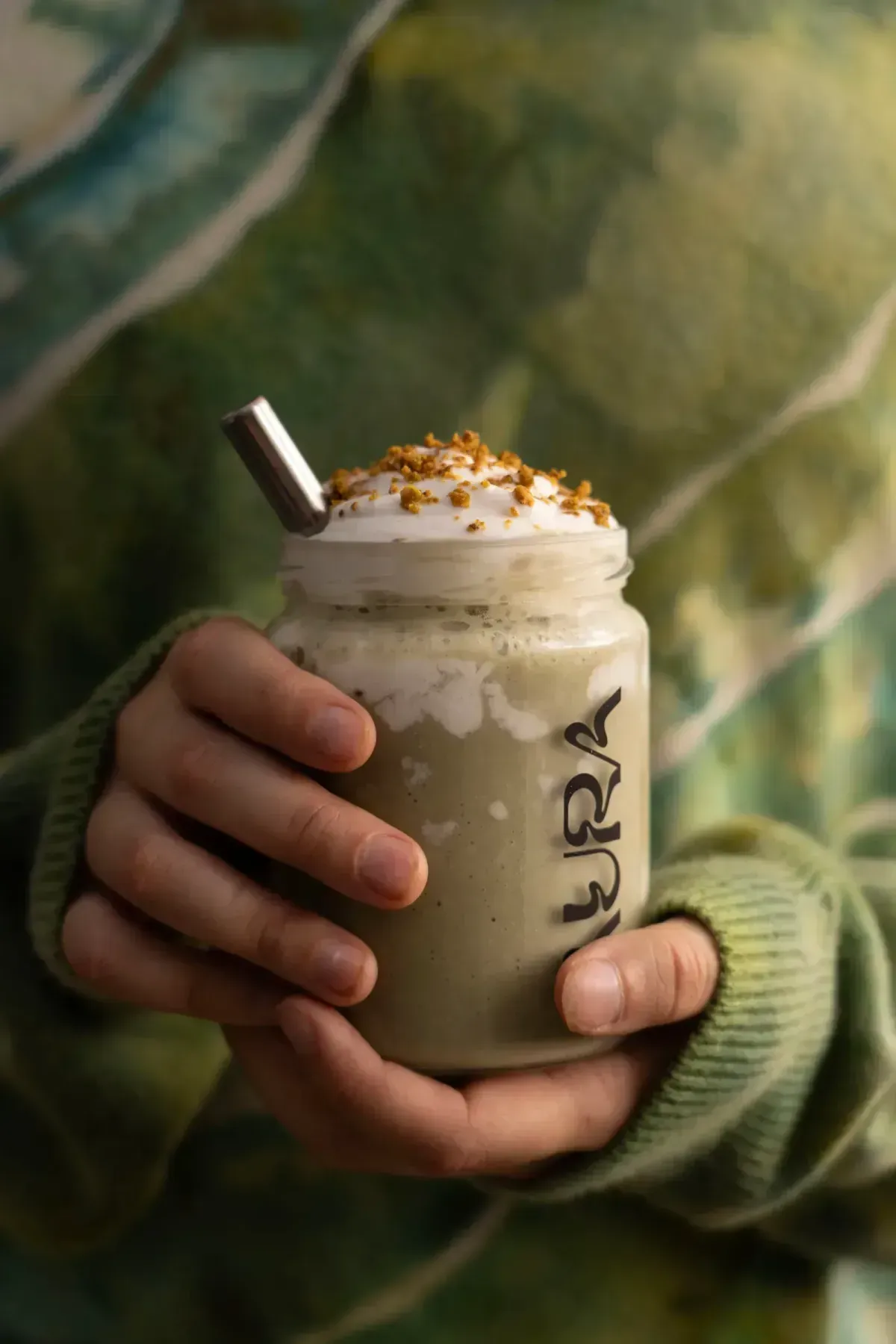
Matcha is everywhere in Lisbon now — and a lot of what's sold as matcha is culinary-grade powder softened with syrup. Real matcha is shade-grown Japanese green tea, stone-ground so finely that you drink the whole leaf. You can judge it before tasting: vivid jade green signals fresh, ceremonial-grade leaf; dull olive signals culinary grade or stale stock. Aura Wellness Bar whisks ceremonial-grade matcha at every Lisbon location and blends it into the JOY smoothie (€11). A ceremonial-grade Matcha Latte is €4.50 at our counters — Earth Matcha €6; Iced Matcha Coconut Cloud, Mango Matcha Latte and Strawberry Matcha Latte €6.50.
Real matcha is shade-grown tea, ground so fine you drink the whole leaf
Matcha begins as tencha, a green tea grown under shade for the final three to four weeks before harvest. Cutting the light changes the leaf's chemistry: it produces more chlorophyll, which gives matcha its saturated green, and it holds on to more L-theanine — the amino acid behind the tea's savoury sweetness — instead of converting it into astringent catechins.
After harvest, the leaves are steamed, dried and stripped of stems and veins, then ground on granite stone mills — slowly, because friction heat dulls both colour and aroma. The result is a powder fine enough to suspend in water. That is the defining difference from every other green tea: you don't steep matcha and discard the leaf, you drink the entire leaf — caffeine, L-theanine, antioxidants and all.
Ceremonial grade is the first harvest; culinary grade is built to survive baking
Ceremonial grade comes from the first spring harvest: the youngest, most shaded leaves, with the most theanine and the least bitterness. It is made to be whisked with water and drunk on its own. Culinary grade comes from later harvests — older leaves, more catechins, a stronger and more astringent profile designed to survive baking, where the flavour has to push through flour, butter and sugar.
Neither term is legally regulated, which is exactly why the cup matters more than the label. A tin can call itself ceremonial and still behave like culinary grade. Colour, aroma and taste are the honest signals — and they are easy to learn.
Matcha's calm energy comes from caffeine paired with L-theanine
A serving of matcha carries roughly 30 to 50 mg of caffeine — noticeably less than most coffees — and that caffeine never arrives alone. Tea is one of the very few dietary sources of L-theanine, an amino acid that crosses the blood-brain barrier. EEG studies associate it with increased alpha-wave activity, the brain state of relaxed alertness. Because matcha is the whole leaf, it delivers more L-theanine per cup than steeped green tea.
The pairing is what makes the experience distinct. In a randomised crossover trial with 27 healthy adults, 100 mg of L-theanine combined with 50 mg of caffeine — roughly a single matcha serving's worth — improved speed and accuracy on an attention-switching task 60 to 90 minutes later, compared with placebo (Owen et al., Nutritional Neuroscience, 2008, DOI: 10.1179/147683008X301513). It is one study, and a small one, so treat it as a plausible mechanism rather than a guarantee of how your own morning will feel. The broader evidence points the same way, though: caffeine for alertness, theanine for keeping that alertness smooth rather than jittery.
Because you consume ground leaf rather than an extraction, the caffeine also lands against a background of fibre — and in a smoothie, fat and protein — so the curve up is slower and the slope down gentler. That is the honest version of "no crash": not zero caffeine, just better company for it. And it still counts: if you're pregnant, caffeine-sensitive, or on medication that interacts with stimulants, treat matcha the same as coffee in your daily total.
Colour, smell and taste are the tells of bad matcha
Look first. Fresh, well-made matcha is vivid jade green. Culinary grade, old stock or oxidised powder drifts towards olive, khaki or brown — the colour fades long before the packaging admits it. Then smell it: good matcha reads as fresh-cut grass with a light sweetness; tired matcha smells of hay and dust.
Taste is the final check. Ceremonial grade has umami sweetness with only gentle astringency. If a matcha latte needs two pumps of syrup to be drinkable, that is usually culinary-grade bitterness being buried, not a flavour choice. Well-ground matcha also whisks into a fine, stable foam — coarse powder won't hold one.
Storage matters too. Matcha oxidises quickly once opened, so a bar that takes it seriously keeps it in small airtight tins, away from heat and light. It will happily show you the powder if you ask — we think that request should always be welcome.
Where is the best matcha in Lisbon?
Honestly: it depends on what you want from the cup. Lisbon now has dedicated matcha specialists and specialty coffee shops that take matcha seriously, and the tells above — jade colour, fresh-grass aroma, a fine stable foam, no syrup needed — will find the good ones faster than any ranking. We are not going to call ourselves the best; we would rather you judge us by the same standard.
What Aura offers is a specific kind of matcha: ceremonial grade, whisked to order at the bar at every Lisbon location, and blended into JOY, our matcha smoothie (€11). If you want it in a cup, a Matcha Latte is €4.50; if you want it alongside cold-pressed juice and functional smoothies, it all sits on the same menu.
Where to drink matcha at Aura in Lisbon
Every Aura location doubles as a matcha bar: we whisk ceremonial-grade matcha at our Campo de Ourique flagship (R. Domingos Sequeira 11A, open Tuesday to Friday from 09:00 to 16:00 and Saturday from 10:00 to 14:00), at Aura inside MVMT Studio in Santos, and at Aura inside Fine Club in Campolide, Lisbon's first Lagree studio. In Porto, you'll find us inside Prescription — that counter has its own guide to matcha in Porto.
What each Lisbon counter pours, at in-store prices:
- Campo de Ourique — R. Domingos Sequeira 11A: Matcha Latte €4.50; Earth Matcha €6; Iced Matcha Coconut Cloud, Mango Matcha Latte and Strawberry Matcha Latte €6.50
- Santos — inside MVMT Studio, R. das Janelas Verdes 128C: Matcha Latte €4.50; Earth Matcha €6; Iced Matcha Coconut Cloud, Mango Matcha Latte and Strawberry Matcha Latte €6.50
- Campolide — inside Fine Club, Rua de Campolide 293A: Matcha Latte €4.50; Earth Matcha €6; Iced Matcha Coconut Cloud €6.50
If you'd rather drink your matcha blended, JOY, our matcha smoothie (€11), pairs ceremonial-grade matcha with mango, pistachio and almond milk, cinnamon and cardamom, plus magnesium, vitamin D and hypericum — the L-theanine keeps the energy calm and steady. It is labelled gluten-free and finished with homemade coconut whipped cream. JOY is also compared, goal by goal, with the other four in our guide to the best smoothies in Lisbon.
Matcha at Aura sits alongside cold-pressed juices, functional smoothies and wellness shots. Our full menulists every ingredient in every drink — the same transparency we would want as customers. And if the sofa wins, we deliver across Lisbon on Uber Eats.