
"Cold-pressed" is printed on a lot of bottles that never saw a press. And "juice vs smoothie" gets argued as if one of them is wrong. They're not competing versions of the same drink. A juice removes the fibre a smoothie keeps — that single mechanical fact is almost the whole difference, and it's why the right choice depends on what you need the drink to do, not which one is "healthier."
Fibre is the whole mechanical difference
Smoothies keep the fibre.Blending breaks fibre down physically but it's all still in the cup. That fibre slows gastric emptying, which does two useful things: it keeps you full longer, and it flattens the speed at which the fruit's sugars hit your bloodstream. A classic crossover study in The Lancet compared whole apples, apple purée and apple juice with identical sugar content: removing fibre made the insulin response markedly steeper and left subjects measurably less satiated (Haber et al., The Lancet, 1977 · DOI: 10.1016/S0140-6736(77)90494-9). That finding has held up for nearly fifty years.
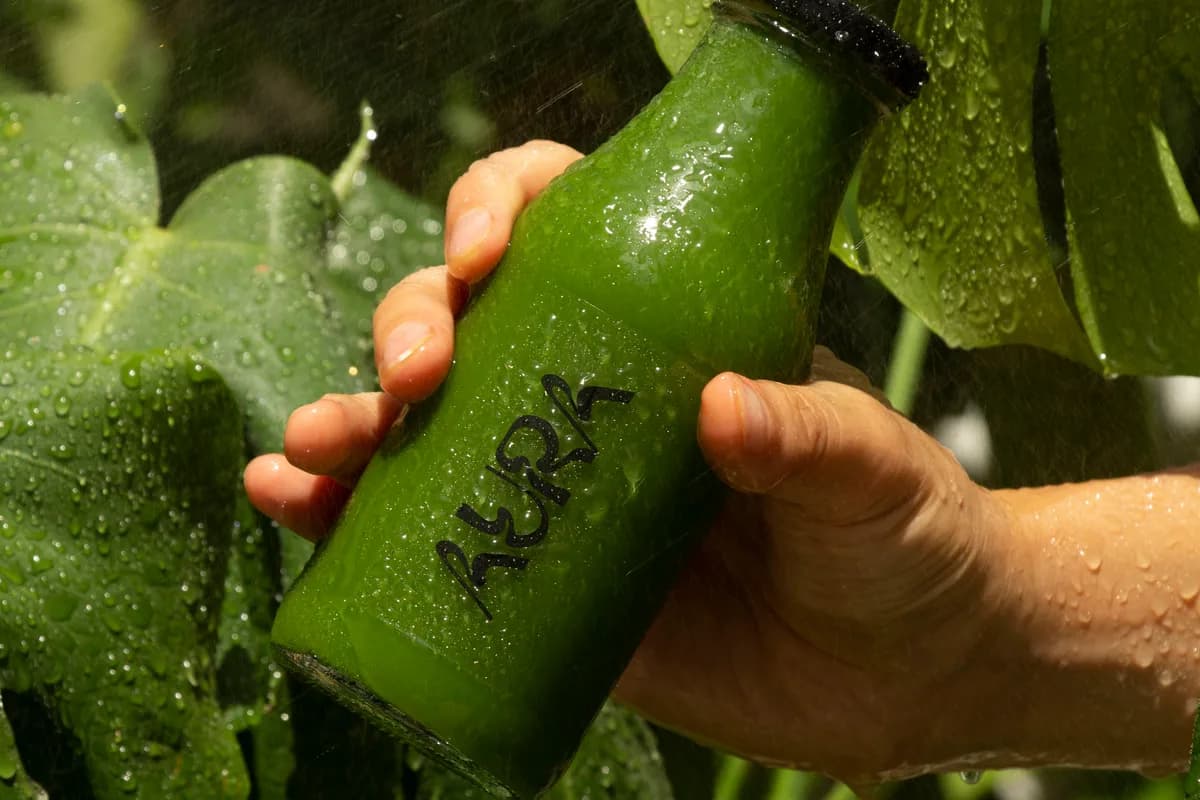
Cold-pressed juices remove the fibre.That's not a flaw — it's the point. With the fibre gone, a single bottle can carry the micronutrients of a quantity of vegetables you would struggle to chew through: our RAW presses spinach, cucumber, celery, lemon, ginger and microgreens into one glass. The trade is real, though: juice is absorbed faster, satiates less, and fruit-heavy juices deliver their sugar quickly. It's why our cleanse roster leans vegetable-forward and why IGNITE is built almost entirely from vegetables — beetroot, cucumber, celery and ginger, with only a squeeze of lime. Neither is superior — a smoothie behaves more like a meal; a juice behaves like a concentrated dose of produce.
Cold-pressed juice comes from a hydraulic press, not a blade
The fibre split above traces straight back to the machine. There are three common ways to turn produce into something drinkable, and they are genuinely different machines:
A hydraulic press— what we use daily in our Lisbon store — works in two stages. Produce is first ground into a pulp, then that pulp is wrapped and squeezed between two plates at thousands of kilograms of pressure. The juice is forced out slowly; the fibre stays behind in the press cloth. No fast-spinning parts, so almost no heat and very little air is whipped into the juice. What comes off the press is dense and still — barely a bead of foam on top, the colour closer to the raw vegetable than to anything from a bottle.
A centrifugal juicer— the standard home and café machine — shreds produce against a grater spinning at around 10,000 RPM and flings the juice through a sieve. It's fast, but the spinning introduces two things a press doesn't: friction heat and a lot of oxygen, both of which degrade the most fragile nutrients (more on that below).
A blenderdoesn't separate anything. The whole fruit — fibre included — is pulverised into suspension. A smoothie isn't "juice with stuff added"; it's the entire ingredient, drinkable.
Why heat and oxidation matter
Some nutrients are robust — minerals don't care how you process them. Others are fragile in two specific ways:
Heat.Vitamin C and several B vitamins begin degrading meaningfully with heat. A hydraulic press adds almost none. A centrifugal juicer's friction adds some. (This is also why "cold-pressed" earned its name — the cold refers to the absence of process heat, not refrigeration.)
Oxygen.Vitamin C, polyphenols and other antioxidant compounds oxidise on contact with air — the same chemistry that browns a cut apple. A centrifugal juicer aerates the juice aggressively; you can see it in the layer of foam on top. A press produces a dense, almost foam-free juice because very little air is incorporated.
The honest case for pressing is a modest one: it loses less of what the vegetables had. It's also why we press every morning in-store and bottle in glass rather than pressing days ahead — the clock starts at the press, whatever the method.
For the full picture of how we press, bottle and deliver across the city, see our guide to cold-pressed juice in Lisbon.
Fresh-pressed juice is a 72-hour product, not a three-week one
An unpasteurised cold-pressed juice is best within about 72 hours, refrigerated in a sealed bottle — and best of all on day one. Pressing gently slows nutrient loss; it doesn't stop it. Vitamin C and the more delicate polyphenols decline steadily from the moment of pressing, which is why the "cold-pressed" on a supermarket bottle with a three-week date tells you something else is going on: usually HPP (high-pressure processing), a pasteurisation alternative that extends shelf life but makes "fresh" a stretch. It's not that pressed juice contains magic — it's that a three-week shelf life and a press are two different stories being told with the same word.
Our answer is logistical rather than chemical: we press every morning in the Campo de Ourique store and sell the same day at the counters, in glass rather than plastic — glass is inert, so nothing leaches into an acidic juice, and the bottles come back to be refilled. If a juice is more than a day or two old, the honest move is to say so on the label. Ours never are.
Choose by goal, not by which one sounds healthier
Committed, by goal — not a diplomatic tie:
Want fullness and slow, steady sugar? Choose the smoothie. The fibre is the reason. ENERGY (ginseng, rhodiola, maca, CoQ10, cold brew) is built for training days — the fibre, banana and protein make it a genuine pre- or post-workout meal. JOY (matcha, magnesium, vitamin D, cardamom) is the steady-energy option for a working afternoon: caffeine arrives buffered by fibre and fat instead of as a spike. If it's replacing breakfast or lunch, it should be a smoothie.
Want your gut resting and a large dose of vegetables? Choose the juice. The missing fibre is the reason here too — it's what lets the vegetable volume in without the digestive work. RAW (spinach, cucumber, celery, lemon, ginger, microgreens) is the green-density option — chlorophyll, electrolytes and minerals without sitting heavy. BALANCE (orange, carrot, lemon, ginger) is the vitamin C and beta-carotene route. Juices suit between-meals, mornings, and anyone who wants vegetables they'd otherwise never get through.
A reasonable default: juice between meals, smoothie instead of one. The goal decides it, not the label on the bottle.
The short version
A hydraulic press squeezes juice out and leaves fibre behind, with almost no heat or air. A centrifugal juicer is faster but hotter and foamier. A blender keeps everything.
Fibre is the functional difference: smoothies keep it (fuller, slower sugar), juices trade it for produce density.
Heat-sensitive nutrients — vitamin C, polyphenols — survive pressing best, which is the legitimate reason cold-pressed exists. Fresh-pressed, unpasteurised juice is a ~72-hour product; a weeks-long shelf life means HPP or pasteurisation.
Pick by goal: juice as a concentrated dose of vegetables, smoothie as a meal. Both come out of the same kitchen at our Campo de Ourique flagship every morning. The full lineup is at aurawellnessbar.com/menu/juices-and-shots.
Aura is a wellness bar in Lisbon. We press on a hydraulic press daily in-store, and we'd rather explain the mechanics than rely on the label.