
Here's the sharpest objection to a collagen smoothie, and it's a fair one: digestion breaks every protein you eat down into amino acids, collagen included — so how could drinking it possibly reach your skin? The sceptic is right about the mechanism; collagen doesn't survive digestion whole and reassemble as skin. What the sceptic is missing is what modern collagen peptides are actually built to do once they're broken down. In controlled trials, that mechanism produces modest but measurable gains in skin elasticity and hydration over eight to twelve weeks. At Aura in Lisbon, that evidence sits behind RADIANCE, our €9 collagen-and-hyaluronic-acid smoothie.
A collagen smoothie works as a signal, not a delivered building block
This is the part the skepticism gets right and the marketing usually skips. Collagen is the structural protein that gives skin its firmness and scaffolding. It's also the one your body makes less of, and repairs more slowly, from your mid-twenties onward. You genuinely cannot drink collagen in its whole form usefully: it's too large a molecule to absorb intact, and digestion does exactly what the objection says. Hydrolyzed collagenis built around that fact rather than against it. Hydrolysis enzymatically snips the protein into short chains of amino acids called peptides, small enough to survive digestion and cross into the bloodstream. Studies using labelled peptides have detected these fragments — including proline-hydroxyproline dipeptides — circulating in blood after ingestion, which is what "bioavailable" means in practice. Once there, they appear to act less as raw building material and more as a signal, nudging skin fibroblasts to step up their own collagen and hyaluronic-acid production. Not a brick delivered to a wall. Closer to a message telling the wall's builders to get back to work.
The strongest evidence is for elasticity and hydration, not wrinkles
Aura is evidence-based, so here is the honest shape of the research behind that signal. The strongest evidence is for skin elasticity and hydration. In a double-blind, placebo-controlled trial, women aged 35 to 55 taking a specific collagen peptide daily for eight weeks showed a statistically significant improvement in skin elasticity versus placebo, with the effect visible by week four (Proksch et al., Skin Pharmacology and Physiology, 2014 · DOI: 10.1159/000351376). Pooled analyses of dozens of later trials point the same way: taken consistently over eight to twelve weeks, oral collagen peptides produce small, real improvements in elasticity and hydration, with weaker and less consistent effects on visible wrinkles. The key words are modest, gradual, and consistent— this is a daily habit that pays off over weeks, not a single drink that resurfaces your face by the weekend.
What a collagen smoothie still doesn't do
The concession up top holds all the way through: it does not become skin, in any literal sense, ever. It does not work overnight, and one smoothie is not a course; the trials that show results run for weeks of daily intake. And it will not out-run the things that age skin fastest: unprotected sun, smoking, poor sleep, and dehydration all matter more than any supplement. A collagen smoothie earns its place as one consistent input among those, not as a substitute for sunscreen.
Why vitamin C belongs in a collagen smoothie
Here is the mechanism most collagen marketing skips. Your own cells can only assemble and stabilise collagen's triple-helix structure with vitamin C as a required cofactor for the enzymes (prolyl and lysyl hydroxylase) that do the work. Peptides supply the signal and some raw material; vitamin C is what lets your fibroblasts actually build. This is established biochemistry, not a marketing pairing. It is why we build RADIANCE on strawberries, which bring vitamin C alongside the collagen rather than leaving that step to chance.
Collagen isn't vegan, and RADIANCE says so plainly
No — and this matters enough to say plainly. Collagen is an animal protein; it is sourced from bovine, porcine, or marine (fish) material, because no plant produces it. Products marketed as "vegan collagen" contain no collagen at all — they supply precursors and cofactors (amino acids, vitamin C, zinc) meant to support your own synthesis, which is a different proposition. This is the one reason RADIANCE is not a vegan smoothie, though it is labelled gluten-free. If you eat fully plant-based, our cold-pressed juices are all vegan, and we would rather you know that than assume every smoothie qualifies.
How RADIANCE is built at Aura in Lisbon
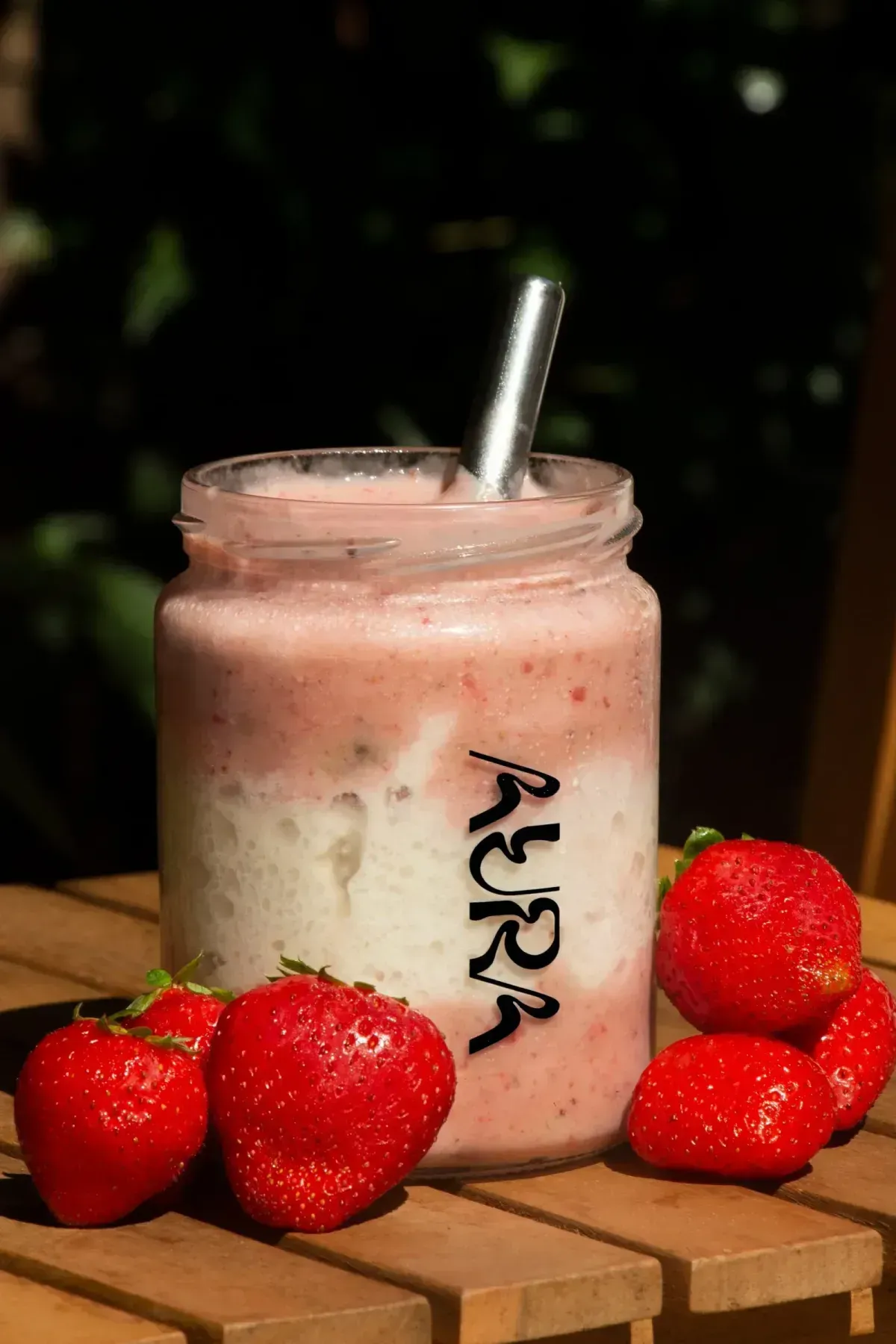
RADIANCE is our answer to the collagen smoothie done properly. Banana and strawberries blended with almond milk, collagen and hyaluronic acid, finished with homemade coconut whipped cream and freeze-dried strawberries — bright, creamy, and built around what skin actually uses, including the vitamin C that makes the collagen worth drinking. It is €9, labelled gluten-free, and on the menu at our Campo de Ourique flagship, inside MVMT Studio in Santos and Fine Club in Campolide, and on Uber Eats across Lisbon.
If you take it up, the practice the evidence actually supports is simple: a glass a few times a week, for eight to twelve weeks before judging it. Elasticity and hydration — not wrinkles — are what to notice first. You can read the full formulation on the RADIANCE collagen smoothie page, see how it sits among our functional smoothies, or dig into each active in our ingredient database.
Aura is a wellness bar in Lisbon. The claims above cite the research they come from — and where the evidence is modest, we say so.