
In adults reporting stress, a daily dose of root extract measurably lowers cortisol and self-reported stress over six to eight weeks. Modest, not miraculous, and real. Ashwagandha is the most-searched adaptogen in the world, and most of what's written about it is either breathless or vague. Neither is useful.
Ashwagandha is a two-thousand-year-old root, extracted for one compound family
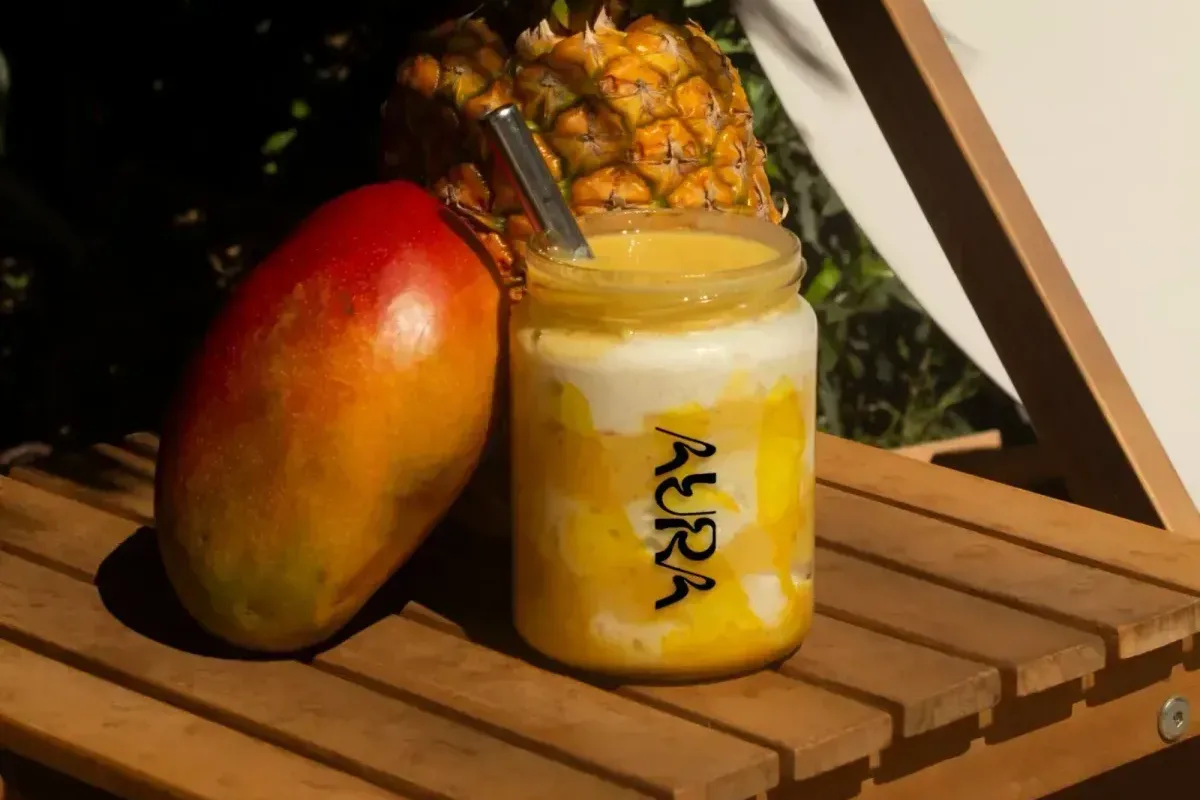
Ashwagandha is the root of Withania somnifera, a small shrub in the nightshade family that has been used in Ayurvedic practice for over two thousand years. The name translates roughly to "smell of the horse" — a reference to the root's earthy odour, not its effects. The extract itself is a fine grey-brown powder, faintly bitter on its own; blended into BLISS, it disappears into the mango and pineapple long before you notice it's there.
What matters for a drink is the extract. Modern trials almost always use a concentrated root extract standardised for withanolides — the steroidal lactones believed to drive ashwagandha's activity. That's also what goes into BLISS: root extract, not ground whole root, because the extract is what the evidence is actually based on.
Ashwagandha is classed as an adaptogen — a compound that appears to moderate the body's stress response rather than push it in one direction. Two thousand years of use is tradition respected; what follows is that claim tested.
Three trials, all pointing the same modest direction
Ashwagandha is one of the few adaptogens with multiple randomised, placebo-controlled human trials behind it. Three are worth knowing:
Cortisol and perceived stress. A 60-day randomised, double-blind, placebo-controlled trial in 64 adults with chronic stress found that 300 mg of high-concentration ashwagandha root extract twice daily reduced serum cortisol by roughly 28% versus baseline, alongside significant reductions on every stress scale measured (Chandrasekhar et al., Indian Journal of Psychological Medicine, 2012 · DOI: 10.4103/0253-7176.106022).
Anxiety and morning cortisol. A 2019 randomised, double-blind, placebo-controlled study in 60 adults found that 240 mg per day of a standardised ashwagandha extract over 60 days reduced anxiety scores (HAM-A) and lowered morning cortisol compared with placebo (Lopresti et al., Medicine, 2019 · DOI: 10.1097/MD.0000000000017186).
Dose response and sleep. An 8-week randomised, double-blind, placebo-controlled study in 58 healthy adults compared 250 mg and 600 mg daily doses: both reduced perceived stress scores and serum cortisol versus placebo, with the higher dose producing the larger effect and a measurable improvement in sleep quality (Salve et al., Cureus, 2019 · DOI: 10.7759/cureus.6466).
The trials are real but mostly small, mostly run in India, and mostly funded by extract manufacturers — typical for the category. The direction is consistent across all three; the effect size is the moderate, not-miraculous kind promised in the opening line.
The effective dose is daily, for weeks — not a single serving
The trials above used between 240 mg and 600 mg of concentrated root extract per day — and crucially, every day for six to eight weeks. No study shows an acute, same-hour effect from a single dose.
That has two honest implications for a smoothie. One BLISS is not a clinical intervention. A single drink contributes a meaningful amount of root extract, but the measured effects in the literature came from consistent daily intake over weeks. Consistency is the mechanism.If you're drinking BLISS for the ashwagandha, a regular habit — a few times a week, over a month or more — is the pattern the evidence supports. What to notice as those weeks pass: not a single afternoon feeling different, but the stress response overall feeling a little less sharp by the time you're a month or two in. A one-off is a very good smoothie.
We'd rather say that plainly than imply a single serving resets your cortisol. It doesn't, and nothing does.
Every ingredient in BLISS is there for a stated reason
BLISS is mango, pineapple, banana and almond milk underneath — tropical and naturally sweet — with four functional ingredients layered in. Each is there for a reason:
Ashwagandha (root extract). The core of the formula, for the cortisol and perceived-stress evidence above.
CBD.A non-intoxicating cannabinoid. The strongest human data — such as a 2011 placebo-controlled trial where 600 mg reduced anxiety in a simulated public-speaking test (Bergamaschi et al., Neuropsychopharmacology, 2011 · DOI: 10.1038/npp.2011.6) — used pharmaceutical doses far above what any food can deliver. At drink levels, CBD is a complement to the calm profile, not a clinical dose. We include it honestly on those terms.
Turmeric.Curcumin, turmeric's active compound, is among the most-studied anti-inflammatory polyphenols. It's poorly absorbed on its own — which is why it sits in a smoothie with almond milk and our homemade coconut whipped cream, since fat meaningfully improves curcumin uptake.
Dandelion root extract. A traditional digestive bitter and a source of inulin, a prebiotic fibre. The human evidence here is thinner than for ashwagandha, and we say so; it earns its place for digestion alongside the bromelain in the pineapple.
The full ingredient list and per-ingredient breakdown is on the BLISS product page, and you can go deeper on every adaptogen we use in our ingredients library.
Ashwagandha suits afternoons, not bedtime
Ashwagandha is not a sedative. In trials it didn't blunt alertness — it moderated stress markers over time. So BLISS is not a "before bed" drink and doesn't need to be saved for a crisis. The pattern that fits the evidence: afternoons, when cortisol-driven tension tends to peak — BLISS was designed to make the afternoon feel a little further away. Regularly, if the adaptogen is your reason for ordering it. Weeks, not minutes, is the timescale the data supports. Alongside the obvious things— sleep, movement, daylight. An adaptogen moderates a stress response; it doesn't replace the basics.
What ashwagandha won't do
It won't fix a bad week in an afternoon. It isn't a treatment for an anxiety disorder — if stress is interfering with your life, that's a conversation for a clinician, not a menu. And anyone pregnant, breastfeeding, on thyroid medication or sedatives should check with their doctor before taking ashwagandha regularly, in any form.
We make this drink because the root extract has real, repeated human evidence behind it — rare in this category.
Where to try it in Lisbon
BLISS is on the menu at our Campo de Ourique flagship (R. Domingos Sequeira 11A), inside MVMT Studio in Santos, and inside Fine Club in Campolide — and in Porto inside Prescription. Full smoothie menu at aurawellnessbar.com/menu/smoothies.
Aura is a wellness bar in Lisbon. Everything we publish about ingredients cites human studies where they exist and says plainly where they don't.